
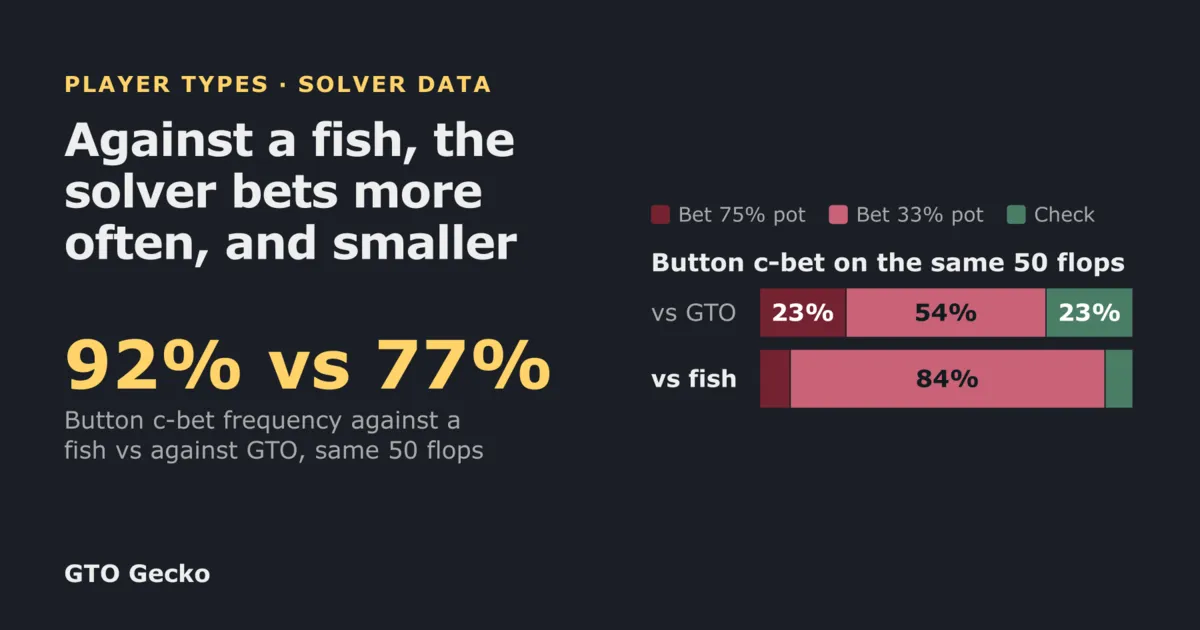
The main poker player types are the fish (or calling station), the nit, the maniac and the tight-aggressive regular. We ran the first three through a solver as profiles. Against the fish profile, the button c-bets 92% of the time instead of 77% and mostly bets small. In the model the fish folds the flop as often as a balanced player but gives up the check-raise. A station that never folds is a different opponent, and the usual advice (bigger value bets, fewer bluffs) is written for that one.
Key takeaways
- Fish profile: check-raises a small c-bet 2.5% of the time (GTO 16%) and folds the flop as often as GTO. The solver c-bets 92% instead of 77%, with 84% of its range at 33% pot. The fish is not passive later: in our turn sample it leads the turn 74% of the time.
- Nit profile: never leads the flop, and in this model calls c-bets more than GTO. The solver bets 88% instead of 77%; the 75% pot size grows from 29% to 39% of the range.
- Maniac profile: leads the flop 40% of the time (GTO 6%). The solver calls those leads more (64% against 57%) and raises them less (22% against 29%).
- What the leak is worth: each time the spot comes up, the button earns 0.14bb more against the fish, 0.05bb against the nit and 0.21bb against the maniac, in a 6.1bb pot.
- What the profiles are: GTO preflop ranges plus two or three postflop incentives each, and the opponent adapts to us.
Where the numbers come from
We make GTO Gecko. The three opponents are the fish, nit and maniac profiles from its Player Types trainer. We read 600 flop solutions against those profiles (50 flops for each type, seat and game, 106 different flops) and compared each with the GTO solution of the same flop. Main game: 8-handed tournament table, 50bb, big-blind ante. The button opens 2.3bb, the big blind calls, the pot is 6.1bb with 47.7bb effective stacks. Flop bets are 33% pot (2bb, "small") and 75% pot (4.6bb, "big"). "GTO" always means the solver against an opponent with no profile.
What are the main poker player types?
The main poker player types come from a two-by-two grid: tight or loose before the flop, passive or aggressive after it. We tested the three corners that have nicknames. The fourth is the tight-aggressive regular, who plays few hands and bets them.
- A fish, or calling station, is a loose-passive player who plays many hands, calls a lot and rarely raises.
- A nit is a tight-passive player who plays few hands, rarely bets without a strong one and gives up under pressure.
- A maniac is a loose-aggressive player taken to the extreme, who bets and raises with almost anything.
A solver needs those descriptions as numbers, and each profile copies a few habits, not the whole player. GTO Wizard introduced the method as player profiles built from action incentives. The opponent gets a small bonus or penalty, as a share of the pot, for each kind of action it takes:
- Fish profile: +4% of the pot for calling, −6% for checking. GTO Wizard's fish uses the same two numbers, in a different spot.
- Nit profile: +7% for folding, +2% for checking, −3% for betting or raising.
- Maniac profile: +6% for betting or raising, +3% for calling, −6% for folding.
This fish profile does not play like a textbook station. It calls where others raise, but the penalty on checking also makes it bet: 98% of the time on the flop when it has the button, and 74% of the time on sampled turns after it calls the flop.
The opponent then plays its best strategy for those distorted payoffs, and our side plays its best strategy against the result. Two things follow. The opponent adapts to what we do, so its frequencies are results of that contest, not fixed habits. And the bias is postflop only: every profile reaches the flop with a GTO preflop range, so a real nit's tighter range and a real fish's wider one are not in this data. For the theory, see what GTO poker means and when to leave GTO for exploitative play.
How does the button's c-bet change against each type?
Against the fish and the nit the button makes its continuation bet more often; against the maniac it bets as often but smaller. Against the fish the button bets big with 8% of its range, small with 84% and checks 8%. GTO on the same flops bets big 23%, small 54% and checks 23%. Against the nit it is 39%, 49% and 12% (GTO 29%, 48%, 23%). Against the maniac, after the maniac checks, 7%, 68% and 25% (GTO 26%, 48%, 26%).
| Opponent | What the button changes |
|---|---|
| Fish: check-raises 2.5% (16%), calls 57% (44%), folds 41% (40%) | C-bets 92% (77%). Small bet 84% of range (54%). More bets on 49 of 50 flops. |
| Nit: does not lead, folds 32% to the small bet (41%) | C-bets 88% (77%). Big bet 39% of range (29%). More bets on 49 of 50 flops. |
| Maniac: leads the flop 40% of the time (6%) | After a check: c-bets 75% (74%), up on 24 flops and down on 22. Small bet 68% (48%), big bet 7% (26%). |
To practice against these three opponents, the Player Types trainer in GTO Gecko deals these exact profiles.
How do you play against a fish that calls but does not raise?
C-bet more hands and use the small size. That is the solver's answer on 49 of 50 flops, with more small bets on all 50 and fewer big bets on all 50. Three things change in this fish's reply to a c-bet:
- The check-raise nearly disappears: 2.5% against the small bet instead of 16%, and 0.1% against the big bet instead of 7%.
- Those raises become calls: the fish calls the small bet 57% of the time instead of 44%.
- The folds barely change: 41% against the small bet (GTO 40%) and 53% against the big one (GTO 52%), even though the button is betting more hands.
The calls are also stronger. Two pair or better makes up 6.5% of the range that calls the small bet, against 3.8% for GTO, and strong hands plus top pairs make up 22% against 17%. Both are higher on all 50 flops, which fits raises turning into calls.
One reading: this fish rarely raises any c-bet (2.5% against the small one, 0.1% against the big one), so more hands can bet. The data cannot test that, and it does not say why the extra bets go to the small size. On the button's side, weak pairs check 11% of the time instead of 35%, top pairs and overpairs use the big size 18% of the time instead of 37%, and hands with no pair and no draw bet 92% instead of 76%.
One flop, two hands: Q♠ 7♥ 5♦
On Q♠ 7♥ 5♦ the GTO button bets small 36%, big 28% and checks 36%.
GTO button on Q♠ 7♥ 5♦
613.19 weighted combos. Full cells show the action mix; entry weight shows how much of each hand class is in the range.
Hover or tap a hand. Use arrow keys in the grid. Suited above the diagonal; offsuit below.
GTO Gecko solver library · 50bb MTT · BTN vs BB · after the big blind checks · pot 6.1bb
Read the range as text
GTO button on Q♠ 7♥ 5♦. Whole range: Bet 4.6bb (75% pot) 27.98%; Bet 2bb (33% pot) 35.88%; Check 36.13%.
Against the fish the same button bets small 73%, big 9% and checks 18%:
The same button against the fish
613.19 weighted combos. Full cells show the action mix; entry weight shows how much of each hand class is in the range.
GTO Gecko solver library · 50bb MTT · BTN vs BB · after the big blind checks · pot 6.1bb
Read the range as text
The same button against the fish. Whole range: Bet 4.6bb (75% pot) 9.04%; Bet 2bb (33% pot) 73.13%; Check 17.84%.
Pocket nines show the frequency change: they check 45% against GTO and bet small 97% of the time against the fish. AQo shows the size change: it bets big half the time against GTO, 21% against the fish, 82% against the nit and never against the maniac.
Is this the calling station the advice is written for?
No, and the difference decides which advice applies. The usual guidance, in Upswing's calling station guide for example, is to bluff less and make bigger value bets, because a station's calling range barely reacts to the price. The fish profile reacts to the price: it folds 41% to a small bet and 53% to a big one. What it lacks is the raise.
The profile we measured almost never check-raises a c-bet and bets when checked to. A player who calls down whatever the price is the one the standard advice is aimed at, and we did not test that player.
The turn adds one habit. In a sample of 54 turn cards on 9 flops, this fish leads the turn 74% of the time after calling the small c-bet (GTO 15%). Against that lead the button calls more (50% against 43%) and raises less (27% against 34%). On the 49 turns where the fish sometimes checks, the button barrels about as often as against GTO (52% against 53%) and does not shift to bigger sizes. The fish folds about 6 points more than GTO to each barrel size.
How do you play against the nit profile?
Against the nit profile the solver bets the flop more often and bigger, and as the big blind it leads more when the nit has the button. The button bets 88% instead of 77%, with the big size at 39% of the range instead of 29%.
The nit's own numbers are the surprise. It does not lead (0% against 5%) and it check-raises less (11% against 15%), but it folds less than GTO. Facing the small bet it folds 32% against 41%, on all 46 flops where the button bets small; facing the big one, 48% against 53%. Its calling range holds more hands with no pair and no draw, 38% against 30%. Part of the reason is visible: some raises become calls. One reading of the rest is the equilibrium itself: the button keeps betting more hands until calling pays again.
Like the fish's 41%, read that 32% as a result of the contest, not a habit. This nit is answering a button that bets 88% of its range, so the number cannot be compared with a fold-to-c-bet stat from a tracker.
On the turn the nit almost never leads. Where the small c-bet was called (48 turn cards on 8 flops), the nit folds 3 to 6 points more than GTO to each barrel size. The other two profiles over-fold the turn too, and the button barrels the nit as often as it barrels GTO: 51%.
When the nit has the button
With position, the nit profile bets big 29%, small 11% and checks back 60% of the time, where GTO checks back 23%. In the big blind you lead more: 15% of the time instead of 6%. When the nit does bet, you fold more: 49% to its small bet (GTO 43%) and 60% to its big one (GTO 56%).
The fish on the button bets big 4%, small 93% and checks 2%. The maniac bets big 15%, small 84% and checks under 1%.
How do you play against the maniac profile?
At 50bb the solver calls the maniac's leads more, raises them less and bets small when the maniac checks. In the big blind this maniac leads into the raiser 40% of the time, where GTO leads 6%. Against that lead the button raises less (22% against 29%) and calls more (64% against 57%). Our donk bet guide covers when a balanced player leads.
When the maniac checks, its range has been filtered. Strong hands and top pairs make up 11% of its checking range against 14% for GTO, lower on 41 of 50 flops and higher on none. Hands with no pair and no draw make up 67% against 59%. The button bets as often as against GTO (75% against 74%) and changes the size: small with 68% of its range instead of 48%, big with 7% instead of 26%. The maniac folds to that small bet 49% of the time (GTO 40%).
On the turn (54 cards on 9 flops) the maniac leads 52% of the time after calling a flop c-bet (GTO 15%). When it checks, the button barrels more (60% against 52%) and bigger: the overbet grows from 24% to 32% of the button's range.
When the maniac has the button, it c-bets 99.5% of the time. In the big blind you fold to its small bet as often as you would against GTO (41%), raise a little less (13% against 15%), call a little more (46% against 43%) and never lead (0% against 6%). Against the fish on the button, which c-bets 98%, you also stop leading (0.2% against 4%), and there you check-raise more (19% against 15%).
What is each leak worth?
In the 50bb game, between 0.05bb and 0.21bb each time the spot comes up. That game has no rake, and the unprofiled player earns this much more over the rest of the hand against a profile than against GTO:
- Against the fish: +0.14bb as the button (2.3% of the 6.1bb pot), +0.07bb as the big blind (1.1%).
- Against the nit: +0.05bb as the button (0.8%), +0.08bb as the big blind (1.3%).
- Against the maniac: +0.21bb as the button (3.5%), +0.10bb as the big blind (1.6%).
This is what the leak is worth when you play the counter-strategy. We did not compute what plain GTO wins against each profile, so we cannot say how much of the gain comes from the adjustment. The gain was positive on all 300 flop solutions; without rake it cannot be negative. In the raked 150bb game the button gains 0.05bb, 0.05bb and 0.02bb against the fish, nit and maniac, and the big blind −0.02bb, +0.10bb and +0.01bb. With rake the game is not zero-sum, so a negative number is possible.
Do the adjustments hold in another game?
The fish adjustment holds, the nit adjustment partly, the maniac adjustment does not. We repeated the comparison on the same flops in a 150bb live cash game: 8-handed, 10% rake capped at 2bb, button opens 2.5bb, pot 5.5bb, flop sizes 40% and 100% pot.
Against the fish, the button bets 56% instead of 43%, and the growth is again in the small size (46% against 30%). Against the nit, the button bets 53% instead of 44%, and the nit again folds less than GTO to the small bet (30% against 35%) on all 43 flops where it faces one. The shift to the big size does not repeat: both sizes grow a little.
Against the maniac the result reverses: the button checks back 78% of the time instead of 56%. That tree gives the big blind no lead, so nothing filters the maniac's checking range the way its 40% leads do at 50bb. That is our best explanation, not a tested one, because depth, rake and bet sizes differ too.
Four findings to take to the table, and what each rests on
- Against the fish profile in the big blind, the button c-bets more hands with the small size. More bets on 49 of 50 flops at 50bb and on 40 of 50 at 150bb, where the small size grew on 35.
- Against a button that c-bets nearly all the time, the big blind stops leading and folds about as often as against GTO. Rests on the fish (98%) and the maniac (99.5%) at 50bb. Check-raises against the small c-bet move in opposite directions: up against the fish (19% against 15%), down against the maniac (13% against 15%).
- Against the nit profile on the button, the big blind leads more and folds more when the nit bets. At 50bb the nit checks back 60% of the time. You lead 15% instead of 6% and fold 4 to 6 points more.
- Against the maniac profile in the big blind, which leads the flop 40% of the time, the button calls that lead more, raises it less and bets small when the big blind checks. Rests on the maniac profile's flop play at 50bb only (GTO leads 6%). The 150bb tree has no big-blind lead, and there the button checks back more.
Drill it
To practice these adjustments on other flops, play the three opponents in GTO Gecko. GTO Gecko is a study tool, for use away from the table.
How we measured 600 flop solutions against three opponents
All numbers come from GTO Gecko's precomputed solver library (see how the solutions are made) and its Player Types set. We read 600 profiled flop solutions (2 games × 3 types × 2 seats × 50 flops; 106 different flops) and the GTO solution of each flop.
Frequencies are weighted by each hand's weight in the range, then averaged over the 50 flops with equal weight. A response to a bet or a lead is averaged only over the flops where that bet is made in both solutions, so some responses rest on fewer than 50 flops. Every comparison is paired: the same flops, with and without the profile.
For the button's c-bet and the big blind's response to the small c-bet, our averages match the library's own flop reports to within 0.02 points. Everything else, including leads and responses to the big bet or to a lead, comes from the solution trees alone. Turn figures use 6 turn cards on each of 9 flops, counted where both strategies reach that turn. EV is read for the unprofiled seat. Drafted with AI assistance from the solver export; every number was re-read from the source files.
Limits
Three specific profiles, with incentives of 2% to 7% of the pot and GTO preflop ranges, against an opponent that adapts. Each cell has 50 flops, and the flop sets differ by type and seat. Two flop bet sizes only. The turn sample is small and covers one line; there is no river data. The reasons we give are readings of the numbers, not tests. One button-against-big-blind spot in two games does not establish what a solver does in 3-bet pots or multiway.
Player type FAQ
How do you play against a calling station?
We tested one kind: a fish profile that, in our 50bb solutions, check-raises a small c-bet 2.5% of the time (GTO 16%) and folds to it 41% (GTO 40%). Both are results of the model, not fixed habits. Against it the button c-bets 92% of the time instead of 77%, mostly at 33% pot. A station that never folds is the player the usual advice targets, and we did not test it.
Is this the maximum exploit?
Against this profile's exact frequencies, yes, within the bet sizes the solver could use: our side plays a best response, and nothing earns more. That best response is not the only one. Hands that mix earn about the same with each action they use, so a node-locked exploit can show more extreme frequencies for the same EV. The catch is where those frequencies come from. The profile kept adapting to us, and a real opponent's frequencies will not match the profile's. The best response to that player is a different strategy, which this data does not give.
Sources accessed : GTO Gecko postflop library and Player Types set (600 profiled flop solutions, their GTO baselines and 216 turn solutions; aggregated views only); GTO Wizard, "Profiles Explained" for the action-incentive model; Upswing Poker on calling stations and DeucesCracked on value betting against them for the conventional advice; Poker Academy on exploiting nits.