

An exploitative poker trainer puts you in a solved spot against an opponent who has one specific, known leak — calls too wide, folds too much, bluffs too often — and grades your decision against the strategy that beats that opponent, not against GTO. GTO Gecko builds those opponents by paying the solver to make the mistake: the Fish gets a 4%-of-pot bonus for calling, the Nit a 7% bonus for folding, the Maniac a 6% bonus for betting. There are 25,196 pre-solved scenarios behind it. Here is how the model works, what it covers, and what it costs.
Disclosure: we build GTO Gecko and Live Poker Trainer. Everything below about our apps comes from the shipping code and the shipping data files, and the competitor prices were checked on August 25, 2026.
What Is an Exploitative Poker Trainer?
An exploitative poker trainer is a drill tool where the villain is deliberately imperfect and your job is to punish the specific way they're wrong. A GTO trainer asks "what does equilibrium do here?" An exploitative trainer asks "what does the highest-EV line look like against a player who folds 70% when equilibrium folds 55%?" Those are different answers, and at small and mid stakes the second one is where the money is.
David Sklansky wrote the reason down decades before solvers existed:
"Every time you play a hand differently from the way you would have played it if you could see all your opponents' cards, they gain; and every time you play your hand the same way you would have played it if you could see all their cards, they lose."
— David Sklansky, The Theory of Poker
Playing GTO against a calling station is playing your hand differently from how you'd play it with their cards face up. It's safe, and it leaves money on the table. If the theory side is new, our guide to GTO vs exploitative play covers when to deviate and by how much. This post is about the drilling.
How GTO Gecko Models a Fish, a Nit and a Maniac
GTO Gecko's Player Types mode ships three archetypes, and each one is a set of signed action incentives: small bonuses or penalties, measured as a share of the pot, applied to that player's bets, calls, checks and folds across the whole game tree. The solver then finds equilibrium against an opponent with those distorted payoffs. The result is a villain with one consistent leak, and a counter-strategy that is mathematically correct against it rather than hand-waved.
These are the actual numbers the app ships, straight out of the profile that gets handed to the solver:
Read the Nit column and you can predict its behaviour before you ever load a hand. A +7% bonus for folding and a −3% penalty for betting produces a player who checks back, folds to pressure, and almost never turns a hand into a bluff. The counter-strategy the solver returns against it bluffs far more than GTO does and folds to its rare aggression, which is exactly the adjustment every coach tells you to make against a nit. The difference is that here you get the frequency instead of the adjective.
Why a Bias Beats a Bot
Most trainers script their villains: "on a monotone board, this bot c-bets 40%." That gets you a strategy that beats that script, and it falls apart one node later when the script has no rule. Biasing the payoffs instead means the leak propagates through the whole tree on its own. The Fish that overcalls the flop is also the Fish that overcalls the turn, calls down light on the river, and — because a −6% check penalty pushes it out of position — donk-bets into you more than a solver ever would.
Why the River Gets Re-Solved on Your Phone
Here's the part that surprised me when I went through the code. GTO Gecko has both an on-device solver and a cloud solver, and for normal GTO work either will do. For Player Types the app will only use the on-device one. The cloud endpoint solves GTO and nothing else, so handing it an archetype profile would silently drop the bias and return a GTO river strategy that looks like an answer.
Rather than serve you that, the app refuses. If the native solver isn't available on your device, a player-type river throws instead of falling back. That's the right call for a training tool, because a wrong answer you can't detect is worse than no answer, and it means every river frequency you're graded against was computed against the archetype, on your hardware, in the seconds after the card came off. The flop and turn come from the pre-solved library. If you want the longer version of how those solves are produced, we published the methodology behind the solution library.
What's Actually in the Library
The Player Types dataset holds 25,196 pre-solved scenario files. They break down as 84 table configurations, meaning a game type, rake structure, stack depth, pot type and position matchup, each available with you in position or out of position, and each of those 168 setups solved separately against all three archetypes. That's 504 distinct configurations, and every one carries its own set of roughly 50 flops drawn from a 109-flop canonical board set.
| Format | Scenario files | Stack depths | Pot types | Position matchups |
|---|---|---|---|---|
| Cash — 6-max, 5% rake capped at 4bb | 13,800 | 100bb | SRP, 3-bet | 34 |
| Cash — 8-max, no ante | 150bb | SRP, 3-bet | ||
| Cash — 8-max, straddle + ante | 200bb | SRP, 3-bet | ||
| MTT (ante) | 7,499 | 50bb, 100bb | SRP, 3-bet | 17 |
| Spin & Go | 3,897 | 15bb, 30bb | SRP, 3-bet, blind vs blind | 7 |
The straddle-plus-ante set at 200bb is the one worth pointing at if you play live. It's an eight-handed tree with a straddle seat in the position list, which is the game a $2/$5 player actually sits in on a Friday night and a game almost no study tool solves at all.
One thing I checked because I expected the opposite: whether the boards change when the opponent does. They don't.
Each configuration gets its own draw of about 50 boards, so switching archetypes doesn't hand you the same fifty flops again. But the mix is matched: two-tone runs 53.4–54.0%, rainbow 39.6–40.1%, paired 18.0–18.2%. That makes the comparison clean. If your accuracy against the Maniac is 12 points below your accuracy against the Nit, it isn't because one of them got the dry boards.
Walking Through One Drill
Most of the screenshots below are from Live Poker Trainer, our free standalone player-type app, because it puts the archetype picker on a screen of its own. GTO Gecko runs its Player Types mode inside the postflop trainer instead, so the setup lives one level deeper. Two separate apps, same idea, and the step order is the same in both.
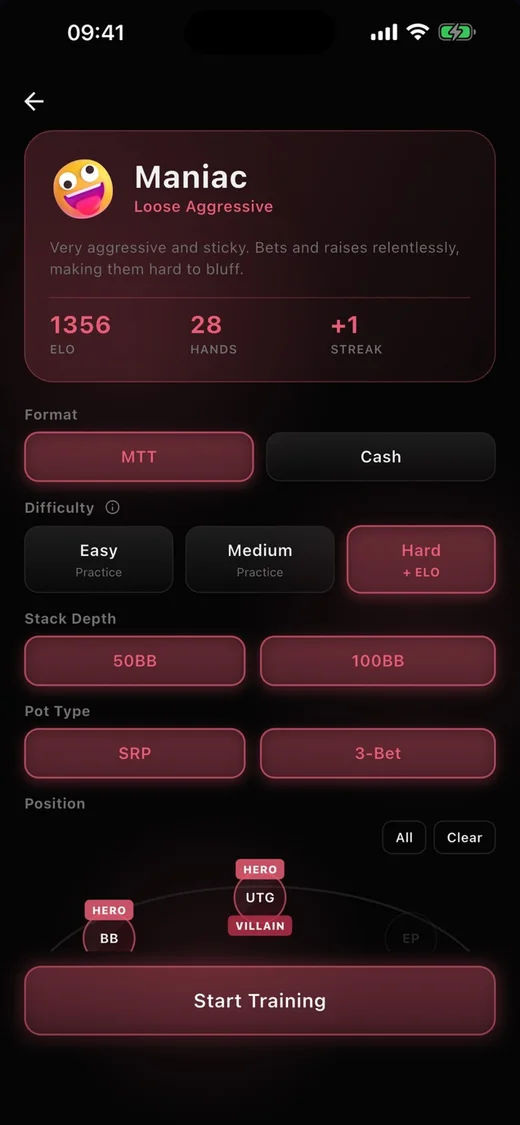
1. Pick the opponent, then the spot. Archetype first, then format, stack depth, pot type, and which seats you and the villain occupy. Difficulty controls the bet-sizing grid: Easy simplifies it, Hard makes you pick the solver's exact sizes.
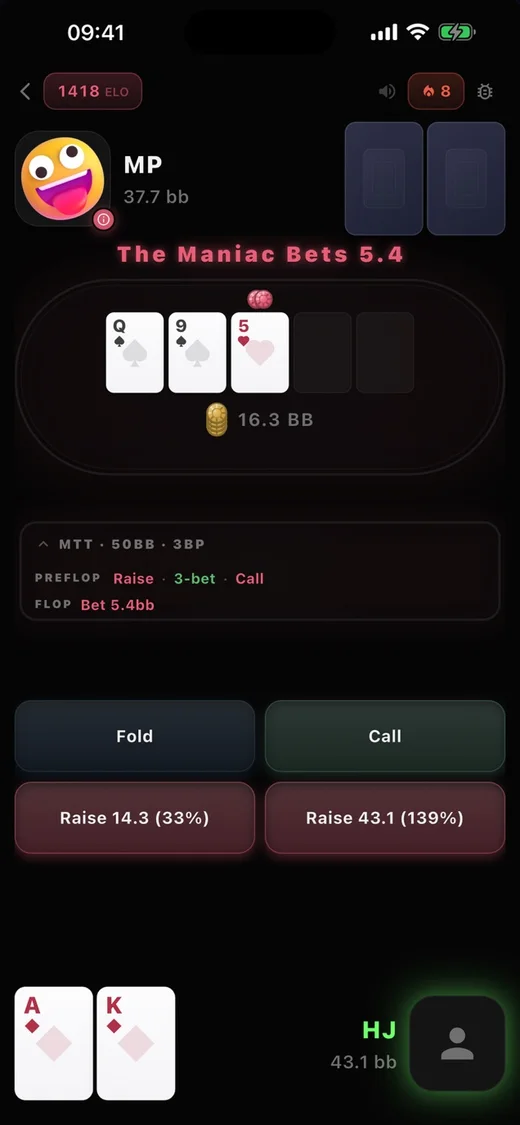
2. Play the hand out. You get the villain's action, the preflop history, the stack sizes and the board, and you pick from real solver sizings. Notice the header: the archetype's name is on the action line, so you always know which leak you're supposed to be attacking.
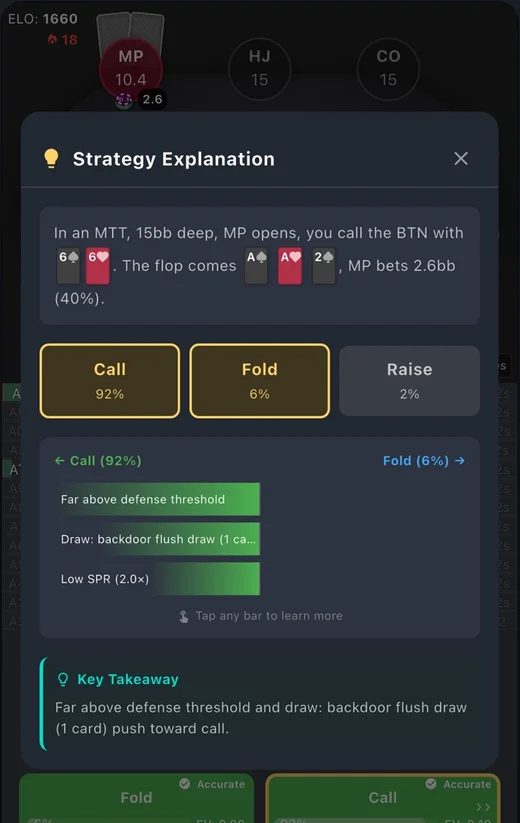
3. Read why you were wrong. This is the part that turns a quiz into study. GTO Gecko's explanation panel gives you the action frequencies, the reasons ranked by weight, and one plain-English takeaway per decision.
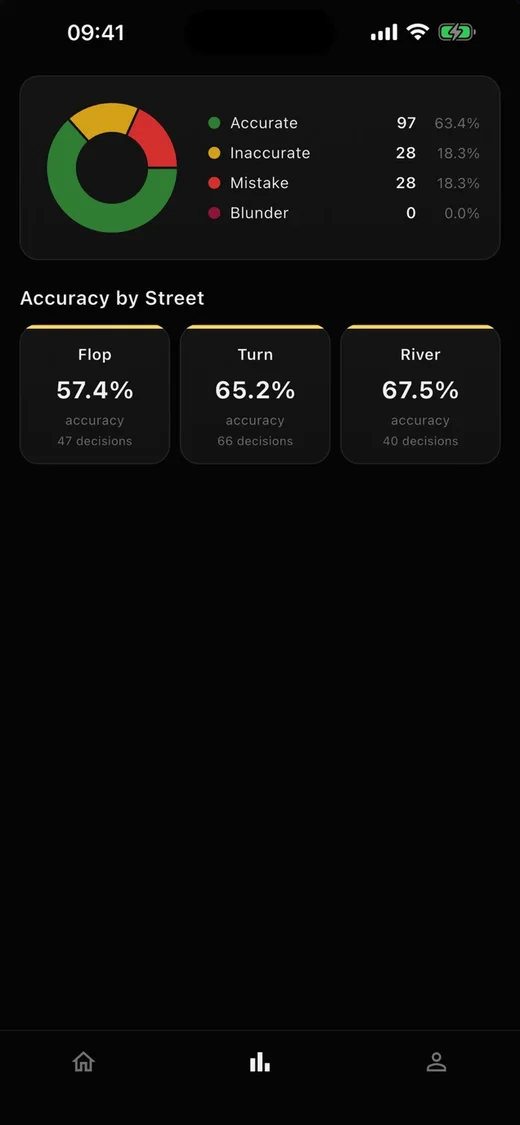
4. Find out which opponent you're losing to. GTO Gecko's statistics page carries an archetype filter across its trainer reports; Live Poker Trainer keeps a separate ELO and hand count per player type. Either way you get the answer a plain GTO trainer can't give you: you might be fine against the Nit and bleeding against the Fish, and until you split the numbers you'd only ever see one blended accuracy figure. For the deeper version of that analysis, our post on finding leaks through EV loss covers how to read the reports.
Where This Approach Breaks Down
Three limits worth knowing before you buy anything.
- It's heads-up. Player Types covers two-player postflop spots only. Three-way pots against a fish and a reg at the same time are the most common live spot there is, and this mode doesn't solve them. GTO Gecko has a separate Multiway Trainer for 3-player single-raised pots, and our multiway strategy guide covers the principles, but the two features don't combine.
- Three archetypes, not fifteen. AceSolver ships 15 villain profiles against our 3. More profiles means finer-grained practice; fewer means each one is a solved, documented bias rather than a label. Which you prefer is a real preference, and I'd rather have three I can print the parameters for.
- Real opponents aren't consistent. The incentive is applied globally, so the Fish overcalls everywhere with the same intensity. Live, the same guy calls three streets light at 11pm and folds the same hand at 1am. Drilling a clean bias builds the reflex; reading which bias is in front of you tonight is a separate skill that lives in betting patterns and physical tells.
What It Costs
Player Types sits in GTO Gecko's Elite tier, and it isn't cheap. Elite for one format is $59.99 a month, $114.99 for three months, or $349.99 a year. Elite Pro, which covers cash, MTT and Spin & Go together, runs $89.99 monthly, $189.99 quarterly or $549.99 a year. The same tier carries the Multiway Trainer and the aggregated reports, so you're not paying that purely for the archetypes.
Base and legacy plans do not include Player Types. The entitlement check is strict about it, and no amount of grandfathering opens it. If exploitative drilling is the reason you're subscribing, Elite is the tier you need, and the annual price is the one that makes sense: $349.99 a year against $719.88 if you pay monthly for twelve months.
GTO Gecko is free to download on iOS and Android, and runs in the browser at play.gtogecko.com. Our full feature walkthrough covers what the other tiers include.
The Free Way to Start: Live Poker Trainer
If $349.99 is not where you are, start with the free one. Live Poker Trainer is our standalone player-type app, and it costs nothing. It ships four opponents rather than three (Fish, Nit, Maniac and a GTO robot), with a separate ELO rating per archetype starting at 1,000, three difficulty levels, cash and MTT formats, single-raised and 3-bet pots, and it works offline, which matters when you're drilling on casino wifi between levels. It sits at 4.7 stars across 143 Google Play reviews on 1,000-plus downloads, and it was last updated on August 8, 2026.
The trade-off is depth, not honesty: Live Poker Trainer gives you the archetypes and the scoring, while GTO Gecko's Elite tier gives you the 25,196-scenario library, the straddle and Spin & Go trees, the on-device river solve and the explanation panel. Drill the free app until you can beat the Maniac consistently, then buy the depth when you've proven you'll use it.
Get Live Poker Trainer on the App Store · Get it on Google Play
Other Exploitative Trainers Worth Knowing
This category grew fast in 2026, and a few of these do things we don't. Prices checked August 25, 2026.
| Tool | Opponent models | Platforms | Price | What it's good at |
|---|---|---|---|---|
| GTO Gecko (ours) | 3 solver-biased archetypes | iOS, Android, web | Elite $349.99/yr per format | Published bias parameters, 25,196 solved spots, live straddle and Spin & Go trees |
| Live Poker Trainer (ours) | 4, including a GTO robot | iOS, Android | Free | ELO per archetype, works offline, no cost to try the idea |
| AceSolver | 15 named profiles | iOS only | Free to download; no price published in the listing | The widest profile roster, and you can switch your own style too |
| XPloit Poker | Archetypes plus an AI coach | Web | Free tier; Grinder $49.99/mo or $490/yr | Conversational hand review on top of the drills |
| Poker Shark | 6 behavioural archetypes | Web | Free in early access | Profiles built from observed live-cash behaviour |
Two honest notes on that table. AceSolver publishes no price anywhere we could find. It isn't in the App Store listing text, and there's no Google Play listing to disclose an in-app purchase range, so "free to download" is all anyone can verify. And Poker Shark's early access is genuinely free right now, which also means its future price is unknown. Neither of those is a knock; it's just what you can and can't check before you commit.
Our position on the rest of it is straightforward. If you want an app that tells you what your opponent's leak is worth in frequencies rather than adjectives, and that will show you the parameters it used, GTO Gecko is the one to buy. Nobody else on that list publishes the bias they solve against.
Exploitative Poker Trainer FAQ
Is exploitative training better than GTO training?
Neither replaces the other. GTO gives you a baseline that can't be counter-exploited, and you need it to know what a deviation even is. Exploitative training teaches you to leave that baseline profitably once an opponent shows you a pattern. Learn the baseline first, using our guide to what GTO poker is as the starting point, then drill deviations against modelled opponents.
How does GTO Gecko decide what a Fish does?
It pays the solver to make the mistake. The Fish profile adds a 4%-of-pot bonus to calling and a 6% penalty to checking, then the solver plays out equilibrium against those payoffs. Nothing is scripted, so the leak shows up consistently on every street and every board.
Can I train against player types for free?
Yes, in Live Poker Trainer, which is free on iOS and Android and covers four opponent types with ELO tracking. In GTO Gecko the Player Types mode is part of the Elite subscription.
Does it cover multiway pots?
No. Player Types is two-player postflop only. GTO Gecko's Multiway Trainer handles 3-player single-raised pots, but without the archetype profiles.
What formats and stack depths are covered?
Cash at 100bb 6-max, 150bb 8-max and 200bb with a straddle and ante; MTT at 50bb and 100bb with antes; Spin & Go at 15bb and 30bb including blind-vs-blind limped and raised pots. Single-raised and 3-bet pots throughout.
Start With the Opponent You Lose To
Pick the archetype that costs you the most money — for most live players that's the Fish, because the correct response is thin value bets that feel uncomfortable — and run a hundred hands against it before you touch anything else. Then check the archetype split in your stats and see whether the number moved. That's the whole loop, and it takes about ten minutes a day.
Open GTO Gecko and drill your first archetype, or grab Live Poker Trainer if you'd rather test the idea for nothing first.
- GTO Gecko Player Types profiles and entitlement rules — shipping app source, verified August 25, 2026
- Player Types scenario library —
playertype_flops.jsonshipped in the GTO Gecko app bundle: 504 configurations, 25,196 scenario files, 109 canonical flops, counted August 25, 2026 - GTO Gecko Elite pricing — in-app plan catalogue, verified August 25, 2026
- Live Poker Trainer on the App Store — feature list, formats and difficulty levels
- Live Poker Trainer on Google Play — 4.7 stars, 143 reviews, 1,000+ downloads, updated August 8, 2026
- AceSolver on the App Store — 15 villain profiles, version 5.8, no published subscription price
- XPloit Poker — free tier and Grinder plan pricing, checked August 25, 2026
- Poker Shark — six archetypes, free early access, checked August 25, 2026
- Upswing Poker on calling stations — standard exploitative adjustments against loose-passive players
- David Sklansky, The Theory of Poker — the Fundamental Theorem of Poker
All product names, logos, and brands are property of their respective owners and are used for identification only. GTO Gecko is not affiliated with or endorsed by AppThemis Technologies, XPloit Poker, or Poker Shark. Pricing verified August 25, 2026 — check each vendor's site for current rates.