
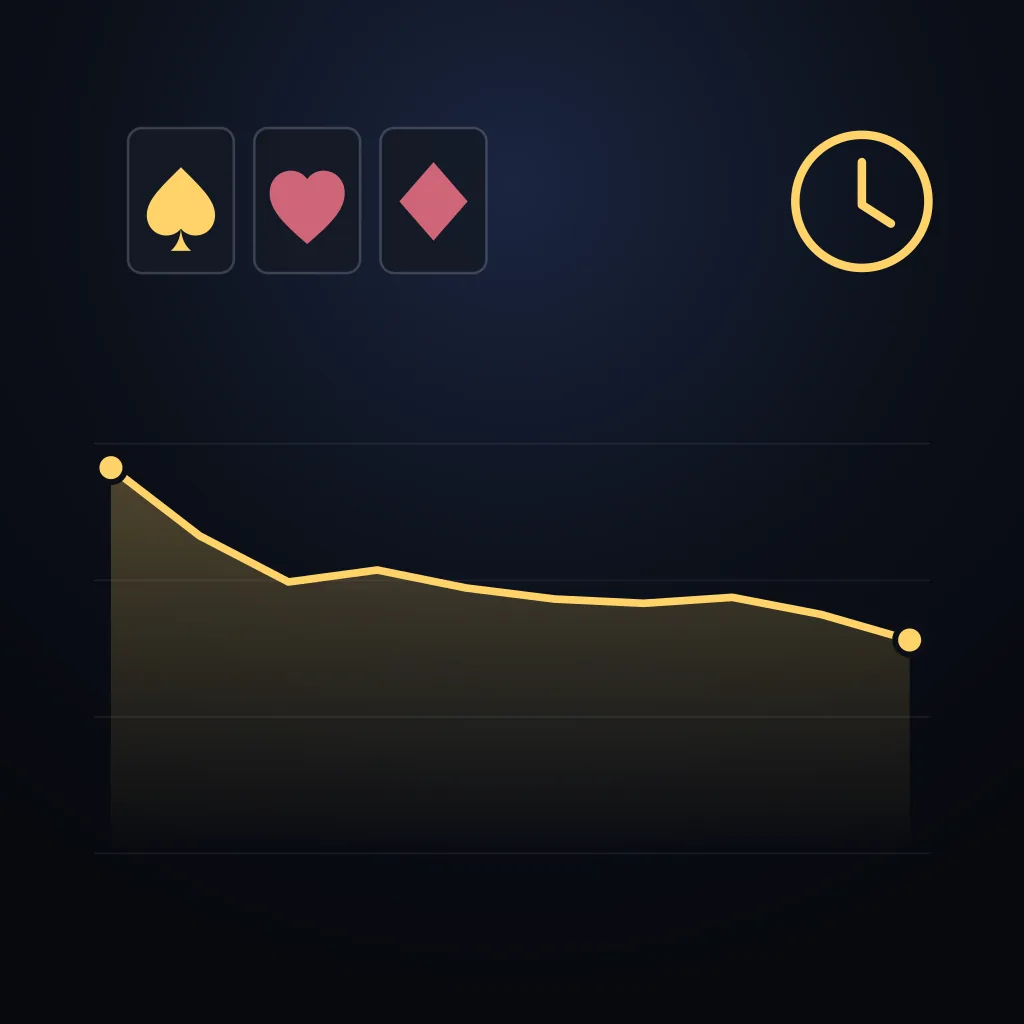
Faster than most players expect, and for longer than most players keep going. We read every synced training history in the GTO Gecko database, 3,002,300 solver-graded decisions from 3,026 players, and asked one question: how many hands, and how many hours, before a player measurably makes fewer mistakes? The first 1,000 graded decisions take about three and a half hours and cut mistakes by 13%. Players who keep going cut them by 20% at 5,000 decisions and by 27% by their 30th training day. And what you practise stays learned: after a two-month break, players come back no worse.
Disclosure: GTO Gecko makes the trainer this data comes from. Everything below is observational product data, with the method and its limits stated in plain language. None of it is a promise about your results at the tables.
What Did We Measure?
Every decision in the GTO Gecko trainer is graded against the solver's strategy for that exact spot and stored. On November 21, 2026 that archive held 3,002,300 decisions in 1,759,785 hands, played by 3,026 players since February 2025: 8,855 hours of active training. Players got 84.6% of those decisions right. A mistake here means the grader scored the decision Mistake or Blunder: an action the solver rarely or never takes that gives up more than 1% of the pot (a blunder gives up more than 5%). That happened on 11.1% of decisions.
Three rules keep the curves honest. First, fixed cohorts: every point of a curve holds the same players, so a trend is never caused by who joined or left. Second, every player counts once, so a few heavy users cannot carry an average. Third, and new in this study, we compare like with like. The trainer does not stay equally hard: players start on opening ranges and move on to 3-bet pots, turns and rivers, where everybody errs more. A raw mistake rate barely moves for a player who keeps being handed harder spots. So each decision is compared with how all other players do on the same kind of spot (same trainer, format, street, pot type, positions and bet-size setting). The result is an index: 1.00 means as many mistakes as the average player on those spots, 0.90 means 10% fewer. Intervals are 95% bootstrap intervals over players.
How Many Hands Until You Make Fewer Mistakes?
About a thousand graded decisions for the first clear step, and the curve keeps falling after that. Among the 539 players who reached 1,000 decisions, the mistake index fell from 1.25 in their first hundred to 1.09 in their tenth: 13% fewer mistakes (interval: 9% to 17%), and 61% of them improved. In raw terms their mistake rate went from 13.7% to 12.6% while the spots got harder.
Players who stayed kept improving. The 108 players who reached 5,000 decisions started 13% worse than the pool on the spots they were given and ended 10% better: 20% fewer mistakes (interval: 13% to 26%), with 73% of them ahead of where they started. Their blunders fell by the same 20%. At 10,000 decisions the drop is 21%, and the raw mistake rate of those 51 players went from 12.4% to 9.7%.
How Many Hours Does That Take?
Less than a weekend. The median player makes 269 graded decisions per hour of active training, about 151 hands. The first 1,000 decisions took a median of 3.4 hours (the middle half of players: 2.6 to 4.3 hours), spread over 8 training days. A live table deals 25 to 30 hands an hour and an online table 75 to 100, and you fold most of them. The 1.76 million hands in this dataset would keep one live table busy for about 65,000 hours. In the trainer they took 8,855.
Measured by the clock instead of by hands, the picture is the same. In their tenth hour of training, 197 players made 18% fewer mistakes than in their first (interval: 12% to 23%), and 73% of them had improved. Measured in days on which a player trained at all, the drop is 22% by the 20th training day (222 players) and 27% by the 30th (110 players; interval: 16% to 36%). Nobody is cramming: a typical training day is 38 decisions in eight and a half minutes, and 68% of sessions last under ten minutes.
Does Practice on a Spot Stick?
Yes, twice over. First, repetition works on the spot you repeat. The first five times players meet a particular kind of spot (say, facing a 3-bet in position on the flop in a cash game), they misplay it 11.7% of the time. By repetitions 51 to 100 it is 9.2%: 21% fewer mistakes on the same spot. That holds for 248 players across 2,226 spots, each met at least 100 times, with 99.98% bootstrap confidence.
Second, the skill does not leak away when you stop. We found 381 comebacks by 266 players after a break of 30 days or more (the median break was 58 days). In the three sessions before the break they misplayed 12.7% of decisions. In the first session back: 12.5%. Like for like, that is no measurable loss (a 2% improvement, with an interval from 9% better to 5% worse). This is what the learning research predicts. In the best-known study of test-enhanced learning, students who were repeatedly tested remembered 61% of the material a week later, against 40% for students who re-read it. A trainer is a test on every hand.
Which Parts of the Game Improve Fastest?
The river is where players lose the most and has the most to gain. It is misplayed on 21.8% of decisions, nearly three times as often as the flop.
Like for like, across a player's first 1,000 decisions on each street, mistakes fell 17% preflop, 15% on the flop, 13% on the river and 8% on the turn. Cash-game players improved faster than tournament players over their first 1,000 decisions (18% against 8%), probably because tournament training spans many more stack depths. The steepest curve belongs to three-way pots, which most players have never studied at all: within the first 500 three-way decisions the mistake rate fell from 14.6% to 11.0%, a quarter lower (41 players).
Where Does the EV Actually Go?
Into folds. We sorted all 326,639 chip-EV mistakes by kind. Folding when the solver continues is only 20% of the mistakes but 36% of all the EV lost: 2.7 big blinds each on average, twice the cost of continuing when a fold was right (1.3 bb). The average blunder costs 3.1 bb, and half of them cost more than 1.1 bb. A strong winning player earns about 5 bb per 100 hands, so one unnoticed habit of folding too much can erase a win rate. If you want to see your own version of this table, that is what a leak finder is for.
How Good Can You Get?
The curve has not flattened where our data ends. The 21 players with 20,000 or more decisions misplayed 11.0% of their first 2,000 and 7.6% of decisions 18,001 to 20,000, 31% fewer. Eighteen of the 21 improved. The in-app rating tells the same story in a single number: across the 539 players with 1,000 decisions it rose from 1,265 to 2,557, and 97% of them finished higher than they started. The rating is a progress score, not a bankroll, but it rises only when decisions match the solver.
Does It Help to Train More Often?
A little, and it costs nothing. Players who trained on 10 or more days in their first month (525 players) gained a median of one accuracy point between their first 100 decisions and their latest 100. Players who trained on four days or fewer (215 players) gained none. The gap is small and the groups are not random, so treat it as a nudge, not a law. It does point the same way as the largest review of practice scheduling ever done (839 assessments), where spaced practice beat cramming in 259 of 271 direct comparisons. For a weekly plan built on this, see how to practice poker.
What Can This Data Not Tell You?
Four things. It is observational: there is no control group that did not train. The long curves hold only the players who chose to keep going; their starting level was close to everyone else's (a 13.3% mistake rate in their first 100 decisions for players who went past 5,000, against 14.2% for players who stopped before 500), but staying is still a choice. These are trainer decisions, not table results, and nothing here promises winnings. And the like-for-like index depends on what counts as the same kind of spot; we used the trainer, format, street, pot type, positions and bet-size setting, and fell back to coarser groups where a spot was rare.
Our August analysis followed the first 100 players session by session and reported raw rates. With ten times as many players it became clear that raw rates depend on which spots the trainer serves, which is why this study compares like with like. The August post stays up as published, together with the research on why drilling works and whether poker is a skill game at all.
So How Long Does It Take to Get Good at Poker?
Nobody can promise you a win rate, but the measurable part looks like this:
- 3 to 4 hours. Your first 1,000 graded decisions, and the first clear drop in mistakes (13%).
- 10 hours. 18% fewer mistakes, and three in four players are ahead of where they started.
- 30 training days. 27% fewer mistakes, in sessions that mostly last under ten minutes.
- 20,000 decisions. Almost a third fewer mistakes than at the start, and the curve is still falling.
The routine the data supports is short and specific: train most days for a few minutes, repeat the spots you misplay until they stop costing you, and look hard at your folds. All of it is how the GTO Gecko trainer is built to be used.
Frequently Asked Questions
How many hands does it take to get good at poker?
In 3,002,300 graded training decisions, the first clear improvement (13% fewer mistakes) arrived within 1,000 decisions, about 560 hands. Players who reached 5,000 decisions made 20% fewer mistakes, and players past 20,000 almost a third fewer. At the tables, published research on 456 million hands puts the point where skill outweighs luck at roughly 1,500 hands.
How many hours a day should you study poker?
Minutes, not hours. A typical training day in our data is 38 graded decisions in eight and a half minutes, and 68% of sessions last under ten minutes. Players who trained on 10 or more days in their first month improved; players who trained on four or fewer did not.
Do you lose your poker skills if you take a break?
Not measurably. After breaks of 30 days or more (median: 58 days), 266 players misplayed 12.5% of decisions in their first session back, against 12.7% just before the break.
Is poker skill or luck?
Over a session, luck. Over a sample, skill. A study of 456 million online hands found that skill dominates chance once results are measured over about 1,500 hands, and our data shows the skill itself is trainable: players make measurably fewer mistakes the more they practise. The earlier post covers that research in detail, and what GTO poker means explains the strategy the trainer grades against.