
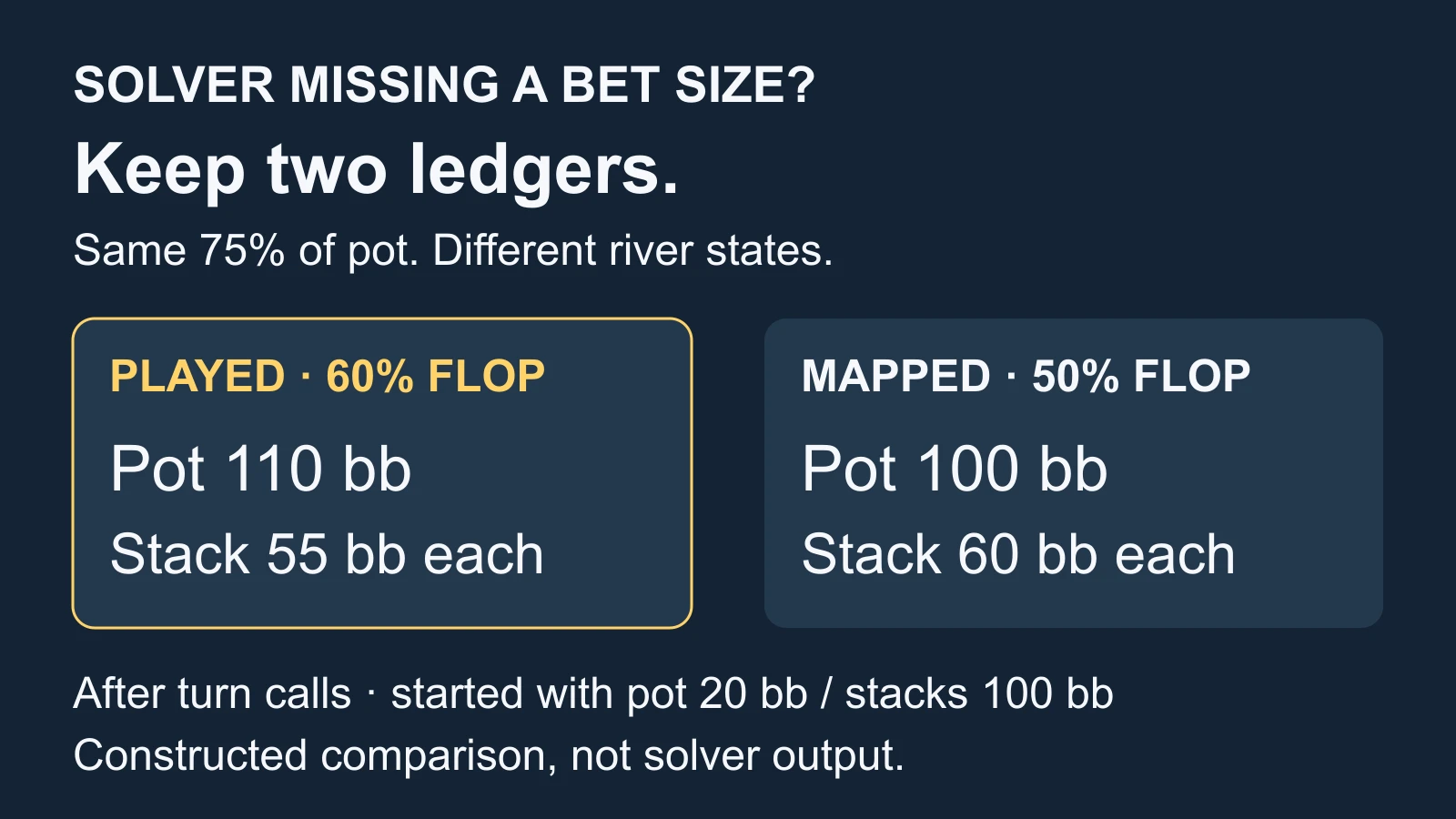
If a poker solver does not contain the bet size from your hand, keep the played hand and the comparison line separate. Record the actual chip amounts, then trace the pot and remaining stacks in each line. A nearby percentage can lead to a different decision state on the next street.
Use this off-table sequence: find the first missing action, preserve its actual amount, write down the available substitute, and compare both states after the response. Decide whether you want a qualitative comparison or a model containing the recorded size and explicit range assumptions before reading an EV number.
What “off-tree” means
A betting tree contains the actions a model permits. A 60%-pot bet is off-tree at a node that offers only 50% and 75% bets. That does not make the played bet illegal or strategically wrong. It means that specific action is absent from the model you opened. An available action displayed at 0% is a different case: it exists in the tree, even if the output assigns it no visible frequency.
The distinction is explicit in PioSOLVER’s tree-building documentation: users configure sizes by street and action, with options for percentage sizes, fixed amounts and extra lines. A tool’s ability to build a tree is separate from the choices included in a particular saved solution.
The problem predates today’s study apps. Ganzfried and Sandholm’s research on endgame solving describes how translating an action into an abstract game can leave its pot and stacks different from the real game. The example below is our own arithmetic illustration of that problem.
Trace the played line beside two comparison lines
Take a constructed heads-up no-limit Hold’em hand at the start of the flop: a 20bb pot and 100bb behind for each player. There is no rake, no ante added later, no side pot and no existing flop contribution. The out-of-position player checks; the in-position player bets and gets called on each street. This fixes an accounting path, not a recommended strategy.
In the played line, the flop bet is 12bb, or 60% of the 20bb pot. Suppose the library offers 50% and 75% instead. We trace both alternatives without claiming either is the correct translation. Every line then uses a 75%-pot turn bet and a river all-in. These are deliberately retained comparison branches, not a claim about how any named app translates hands. Software may expose discrepancies or calculate a new later-street state; check what the tool actually does.
On a narrow screen, scroll horizontally to read every column. All chip amounts are big blinds (bb).
| Line | Flop bet | Pot after call | Each stack after call | SPR |
|---|---|---|---|---|
| Played 60% | 12 | 44 | 88 | 2.00 |
| Mapped 50% | 10 | 40 | 90 | 2.25 |
| Mapped 75% | 15 | 50 | 85 | 1.70 |
For an opening bet and full call with zero prior street contributions, new pot = old pot + 2 × bet; each player’s remaining stack falls by the bet. Thus the played line becomes 20 + 12 + 12 = 44bb, with 88bb each behind. Its stack-to-pot ratio (SPR) is 88 / 44 = 2.
Calling the 50% branch “close enough” does not make its 40bb pot a 44bb pot. Nor does changing only the displayed pot fix its 90bb remaining stacks. Maintain the whole state consistently.
The same next percentage produces different chip bets
Each branch bets 75% of its own turn pot. That is 33bb in the played line, 30bb after the 50% substitute and 37.5bb after the 75% substitute. Once those bets are called, the river starts from three different states.
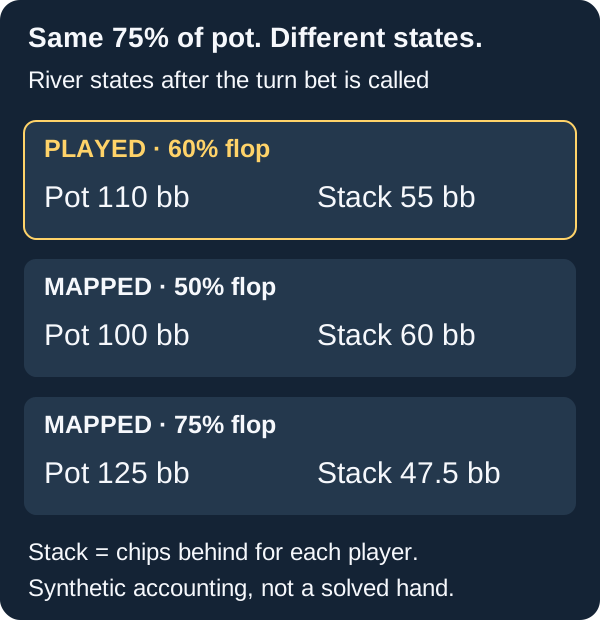
Scroll horizontally on a narrow screen. “River call” is the amount needed to call the other player’s remaining-stack shove.
| Line | Turn bet (bb) | River starting pot (bb) | River call (bb) | Final pot if called (bb) | Break-even share |
|---|---|---|---|---|---|
| Played 60% | 33 | 110 | 55 | 220 | 25.00% |
| Mapped 50% | 30 | 100 | 60 | 220 | 27.27% |
| Mapped 75% | 37.5 | 125 | 47.5 | 220 | 21.59% |
The played river call costs 55bb to contest a final 220bb pot: 55 / 220 = 25%. The 50% substitute produces 60 / 220 ≈ 27.27%. That is about 2.27 percentage points higher, even though both lines eventually put the same total chips in the pot. The 75% substitute produces 47.5 / 220 ≈ 21.59%. All three final pots equal 220bb because they contain the same initial 20bb plus both full 100bb stacks. That equality does not restore the earlier states.
These are chip-EV break-even expected showdown pot shares for the final call, relative to folding. The share includes ties: a heads-up tie returns half the pot. No further betting remains after this call. They are not measured hand equities, bluff frequencies or solver recommendations. We supplied no cards or ranges. The 2.27-point change is a difference in call price, not a measured change in equity or an EV loss caused by rounding. For the underlying call formula, see our pot-odds explanation.
A worksheet for a missing bet size
Keep these fields beside your review. Use one comparison column per candidate line, rather than silently overwriting the played hand.
- Identify the last matched state. Record street, board, positions, pot, each remaining stack, current-street contributions, rake convention and action history. Preserve known cards and range assumptions too.
- Write the divergence in chips. “Played 12bb into 20bb; comparison uses 10bb” is more informative than “60 maps to 50.” For raises, distinguish the total raise-to amount from the additional chips put in.
- Advance each line separately. After a response, recalculate contributions, pot, stacks and next action. Label whether later bets preserve a percentage or a chip amount.
- Label the study claim. “This modeled range mixes here” is a comparison observation. Record where those range inputs came from and which prior size selected the range arriving at this node. “My actual call lost 0.3bb” needs evidence from a model that supports that exact claim.
Download the printable two-ledger worksheet for a blank review sheet and this worked example. If a hand amount is unknown, use the hand-notes method to preserve the uncertainty before choosing a substitute.
Choose what the comparison can answer
A nearby branch may help you ask why the modeled range bets, checks or continues. Keep the claim attached to that branch. Comparing both neighboring sizes can reveal sensitivity, but their frequencies and EVs are not proven bounds for the missing action. A weighted average is not a newly solved strategy. There is no universal “within 5% is safe” rule in this worksheet.
If an exact-size investigation matters, use a tool that supports the required inputs and build a model containing that action. Verify the resulting tree, ranges, pot, stacks, allowed responses and solve accuracy. Starting a later-street model with the actual pot and stacks repairs those numerical inputs; it does not establish which ranges arrived there. As the same paper’s analysis of endgame replacement shows, solving a later subgame alone is not a general guarantee of an equilibrium strategy for the entire original game.
Sometimes the useful outcome is an unresolved question. Record the missing size and what remains uncertain, then return when you have a suitable model. For a real example of limits on a nearby stored solution, our Dwan–Schwimer hand analysis separates the reported hand from the selected model.
For routine study, we recommend starting with GTO Gecko and inspecting the configuration of an available precomputed spot before drilling it. Its current official listing describes precomputed scenarios for studying actions, frequencies and EV estimates. A paid plan is required, and available libraries depend on scope. Inspect the actions in the selected tree; this does not promise that an arbitrary missing size can be inserted. GTO Gecko is published by our team; the worksheet and numbers here are independent teaching materials, not a report of its size-mapping behavior.
Reproduce the example
Research and product checks: September 7, 2026. The method and download instructions link the inputs, exact rational results, CSV, generator and independent verifier. This is a deterministic three-branch calculation: no samples, random seed, proprietary ranges or user records are involved.
The ledger assumes equal full stacks, matched bets and calls, and no rake or side pots. It does not measure how often a line occurs, estimate the strategic cost of translation, or rank mapping algorithms. Use the two ledgers to mark the first divergence and carry it forward before making a claim about a later decision.