
You bet J♠ 7♠ 3♥ with J♦ 4♦, then check back the 2♦. The river is 6♣, and the big blind checks. Is your kicker a reason to take showdown—or to make the smallest value bet?
In this conditional river model, both choices leave value behind. Betting 6.1bb into 9.1bb returns 1.219bb more than checking and 0.379bb more than betting 3.6bb. The weak kicker does not make the smallest size best.
That is a result for these ranges and continuations. This study uses twelve river scenarios built from the owned solve library; the explanations are our interpretation of the output. Achieved convergence is unavailable, and some other hands fail an EV/frequency consistency check. Treat the figures as model comparisons, not certified equilibrium advice.
One more value bet with J♦ 4♦?
100bb cash. BTN opens 2.5bb; BB calls. Flop J♠ 7♠ 3♥: BB checks, BTN bets 1.8bb, BB calls. Turn 2♦ checks through. River 6♣: BB checks.
River: J♠ 7♠ 3♥ 2♦ 6♣. BTN holds J♦ 4♦.
Swipe the table sideways to see all six seats.
Conditional river model with 9.1bb in the pot and 95.7bb behind. No added river rake. Chips are illustrative; amounts are labels. Chips are illustrative; the labels are the amounts.
Read the table as text
100bb cash. BTN opens 2.5bb; BB calls. Flop J♠ 7♠ 3♥: BB checks, BTN bets 1.8bb, BB calls. Turn 2♦ checks through. River 6♣: BB checks. Pot: 9.1 bb. Board: Js, 7s, 3h, 2d, 6c.
- UTG: 100 bb behind; 0 bb committed this street; Fold preflop; folded; cards: face down, face down.
- HJ: 100 bb behind; 0 bb committed this street; Fold preflop; folded; cards: face down, face down.
- CO: 100 bb behind; 0 bb committed this street; Fold preflop; folded; cards: face down, face down.
- BTN (dealer): 95.7 bb behind; 0 bb committed this street; Check or bet; next to act; cards: J♦, 4♦.
- SB: 99.5 bb behind; 0 bb committed this street; Fold preflop; folded; cards: face down, face down.
- BB: 95.7 bb behind; 0 bb committed this street; Check; cards: face down, face down.
Study cue: a weak kicker does not decide the river size. Compare what worse hands still call the next size up, and account for the raises you face. The flush-completing ace-high example below shows where checking wins.
The decision: how much does a second bet earn?
All cases start with 100bb cash stacks: BTN opens to 2.5bb, BB calls, then checks and calls a 1.8bb flop bet. Both players check the turn. The upstream flop tree imposes BB’s check. The new river tree allows leads as well as checks, so we condition on the hands that actually check. The river starts with 9.1bb in the pot and 95.7bb behind.
The conditional river tree allows BB to lead or check. BTN can check or bet 3.6, 6.1, 11.4, 22.8 or 95.7bb. The first two bets are about 40% and 67% of the pot; 11.4bb is an overbet. Check-raises and further responses remain available.
Swipe the table sideways to compare all actions. Hand labels stay visible.
| Hand / river | Check | Bet 3.6bb | Bet 6.1bb | Bet 11.4bb | ||||
|---|---|---|---|---|---|---|---|---|
| Frequency | EV (bb) | Frequency | EV (bb) | Frequency | EV (bb) | Frequency | EV (bb) | |
| J♦ 4♦J♠ 7♠ 3♥ 2♦ 6♣ | 0.0% | 8.096 | 0.0% | 8.936 | 72.0% | 9.315 | 28.0% | 9.379 |
| K♣ 4♣K♠ 8♠ 3♥ 2♦ 7♣ | 0.0% | 8.003 | 0.0% | 8.818 | 100.0% | 8.993 | 0.0% | 8.724 |
| Q♥ 4♥Q♠ 8♠ 3♥ 2♦ 6♣ | 0.0% | 8.175 | 0.0% | 8.945 | 100.0% | 9.180 | 0.0% | 9.124 |
With J♦ 4♦, the returned mix uses 6.1bb 72% of the time and 11.4bb 28%. The displayed EV difference between those two sizes is 0.064bb. That is too little, with unknown convergence, to declare one the precise answer. Their advantage over checking is much larger. The 0.443bb smallest-bet shortfall quoted later uses 11.4bb, the highest returned EV, as its benchmark; the opening 0.379bb comparison uses 6.1bb.
EV here is measured from the river decision: the already-built pot can be won, while future money put in is a cost. An EV above the 9.1bb pot is possible because an opponent can pay an additional bet. We compare actions within the same node.
Follow the worse calls
For J♦ 4♦, the relevant question is which hands in BB’s checked range will pay another bet. The following grids show both players at this decision. BTN’s range has already been filtered by its turn check-back; BB’s range includes its turn and river checks.
In the jack-high example, BB’s checked range is 48.9% one-pair hands, 45.3% high card, 3.7% sets and 2.2% two pair by marginal combination weight. It contains no straight mass at the exported precision. BTN’s range is different: 51.7% one pair, 44.6% high card and 3.7% two pair or better. These composition shares describe the ranges; they are not their equity.
BTN after checking back the turn
57.07 weighted combinations before conditioning on the opponent’s exact cards. Entry weight shows presence; colored segments show the conditional action mix.
Swipe the grid sideways to see every hand. Use the hand selector for exact frequencies.
Hover or tap a hand. Use arrow keys in the grid. Suited above the diagonal; offsuit below.
Conditional river model, September 28, 2026. Rounded inputs/output; achieved convergence unavailable. Hatched = outside range · ? = missing data
BB’s checked range facing 6.1bb
101.97 weighted combinations before conditioning on the opponent’s exact cards. Entry weight shows presence; colored segments show the conditional action mix.
Swipe the grid sideways to see every hand. Use the hand selector for exact frequencies.
Hover or tap a hand. Use arrow keys in the grid. Suited above the diagonal; offsuit below.
Conditional river model, September 28, 2026. Rounded inputs/output; achieved convergence unavailable. Hatched = outside range · ? = missing data
Swipe the table sideways to compare all actions. Hand labels stay visible.
| BTN bet | BB calls | Worse call mass | Better call mass | BB raises |
|---|---|---|---|---|
| 3.6bb | 52.8% | 49.98 | 0.15 | 17.2% |
| 6.1bb | 43.6% | 40.01 | 1.09 | 14.1% |
| 11.4bb | 32.2% | 26.58 | 3.60 | 10.3% |
Moving from 3.6bb to 6.1bb reduces BB’s calling share from 52.8% to 43.6%. Yet 40.01 weighted combinations still call with a worse hand, against 1.09 better calls and 0.39 ties. Those are weighted combination masses, not counts of whole hands. Concrete worse calls at 6.1bb include 8♥ 8♣ and A♣ 7♣; both retain positive weight after BB checks.
This explains why “get called more often” is an incomplete sizing rule. The larger bet collects more when called by worse. It also changes folds, better calls and raises: BB raises 14.1% against 6.1bb in this hand-conditioned comparison. The action EV includes the subsequent responses; worse-call counts alone cannot calculate its value.
At 11.4bb, worse calls fall further to 26.58 weighted combinations and better calls grow to 3.60. Its slightly higher returned EV is not evidence that ever-larger bets keep improving. Both 22.8bb and the shove return less for this hand.
Test the smallest-bet shortcut across rivers
Before evaluating the held-out cases, we set a concrete screen: the 3.6bb bet should be within 0.1bb of the best returned action for at least 95% of weak-top-pair range weight in each primary scenario. “Weak top pair” means exactly one pair, matching the highest board rank, with a kicker of 9 or lower.
The six primary rivers contain 207 eligible exact-hand rows; 129 belong to four held-out flop families. Five scenarios fail that screen, including all four held out. The first two rows below are discovery cases; the remaining four were held out. A pass means no more than 5% of eligible range weight exceeds the 0.1bb gap. One failure is borderline: on A♠ 8♠ 5♥ 2♦ J♣, the largest small-bet shortfall is only 0.105bb. Moving the cutoff to 0.2bb leaves two failures rather than five.
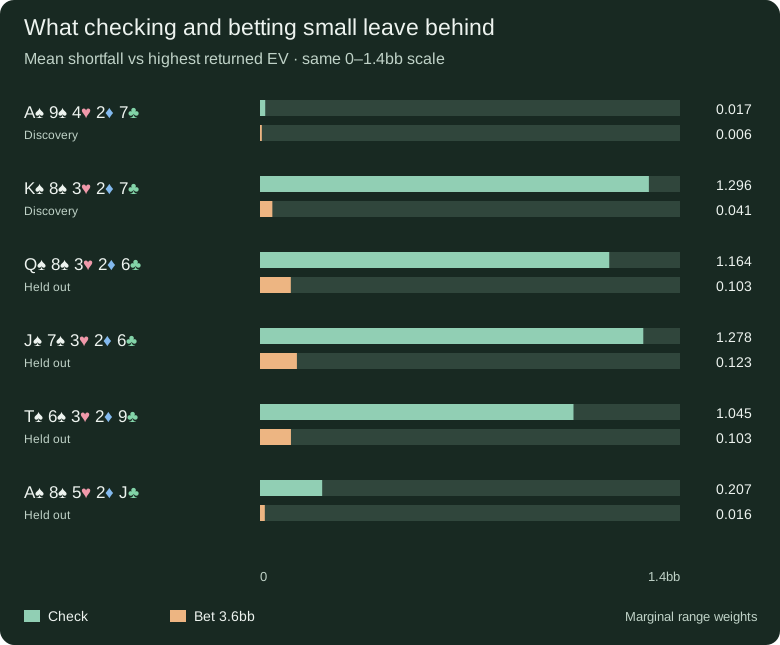
Mean local EV shortfall vs highest returned EV. Each bar uses the same 0–1.4bb scale.
Swipe the table sideways to compare all actions. Hand labels stay visible.
| River board | Hands | Mean check gap | Mean small-bet gap | Small-bet gap >0.1bb |
|---|---|---|---|---|
| A♠ 9♠ 4♥ 2♦ 7♣ | 48 | 0.017bb | 0.006bb | 0.0% |
| K♠ 8♠ 3♥ 2♦ 7♣ | 30 | 1.296bb | 0.041bb | 14.2% |
| Q♠ 8♠ 3♥ 2♦ 6♣ | 21 | 1.164bb | 0.103bb | 29.0% |
| J♠ 7♠ 3♥ 2♦ 6♣ | 30 | 1.278bb | 0.123bb | 41.9% |
| T♠ 6♠ 3♥ 2♦ 9♣ | 18 | 1.045bb | 0.103bb | 65.3% |
| A♠ 8♠ 5♥ 2♦ J♣ | 60 | 0.207bb | 0.016bb | 10.0% |
The smallest bet has a lower mean shortfall than checking in all six primary cases. That does not make it uniformly close to the best size. A useful study cue is to compare the small bet with the next size up, then inspect the response range—especially when taking showdown gives up substantial value.
These are unpaired, non-spade rivers, not a collection of harmless “blanks.” For example, 5♣ 4♣ makes a straight on J♠ 7♠ 3♥ 2♦ 6♣. That hand leads before BTN acts in this model, so it is absent from the checked range. The board alone does not tell you which strong hands remain after a check.
The river where checking wins
Now keep A♦ 3♥ and change the last card on A♠ 9♠ 4♥ 2♦ 7♣ from 7♣ to 7♠. On the club river, the small bet and check differ by only 0.028bb. On the spade river, betting 3.6bb returns 0.275bb less than checking.
Swipe the table sideways to compare all actions. Hand labels stay visible.
| Hand / river | Check | Bet 3.6bb | Bet 6.1bb | Bet 11.4bb | ||||
|---|---|---|---|---|---|---|---|---|
| Frequency | EV (bb) | Frequency | EV (bb) | Frequency | EV (bb) | Frequency | EV (bb) | |
| A♦ 3♥A♠ 9♠ 4♥ 2♦ 7♣ | 16.8% | 7.710 | 59.4% | 7.738 | 23.8% | 7.722 | 0.0% | 7.470 |
| A♦ 3♥A♠ 9♠ 4♥ 2♦ 7♠ | 100.0% | 6.854 | 0.0% | 6.579 | 0.0% | 6.204 | 0.0% | 5.083 |
BTN after checking back the turn
51.22 weighted combinations before conditioning on the opponent’s exact cards. Entry weight shows presence; colored segments show the conditional action mix.
Swipe the grid sideways to see every hand. Use the hand selector for exact frequencies.
Hover or tap a hand. Use arrow keys in the grid. Suited above the diagonal; offsuit below.
Conditional river model, September 28, 2026. Rounded inputs/output; achieved convergence unavailable. Hatched = outside range · ? = missing data
BB’s checked range facing 3.6bb
89.52 weighted combinations before conditioning on the opponent’s exact cards. Entry weight shows presence; colored segments show the conditional action mix.
Swipe the grid sideways to see every hand. Use the hand selector for exact frequencies.
Hover or tap a hand. Use arrow keys in the grid. Suited above the diagonal; offsuit below.
Conditional river model, September 28, 2026. Rounded inputs/output; achieved convergence unavailable. Hatched = outside range · ? = missing data
The completed flush changes what top pair beats and what can continue. Here BB’s checked range retains 5.77% flushes by marginal combination weight; the exact cards still matter within top pair. The displayed model checks A♦ 3♥ every time on the spade river. Across all six flush-completing boundary scenarios, five fail the small-bet screen, but the ten-high case passes. A third spade is a reason to reassess the range, not an automatic instruction to check every top pair.
What the model can—and cannot—settle
The upstream library is catalogued as 5% rake with a 4bb cap. The new conditional river solves add no rake and use neutral opponent profiles. They condition on the library’s reached turn ranges; they do not re-solve the earlier streets. Original solver/version, full abstraction and achieved convergence are unavailable.
Inputs and action frequencies are rounded to two decimals. We renormalized action mixes within their rounding bounds and retained only positive serialized range weights. A second input approximation scales each player’s range proportionally before rounding, preserving more detail. All four selected reruns preserve their original screen verdicts, including the ace-high spade boundary. For J♦ 4♦, the smallest-bet shortfall changes from 0.443bb to 0.385bb; the spade-river A♦ 3♥ loss changes from 0.275bb to 0.261bb. This sensitivity tests input quantization; it does not certify convergence.
Our consistency screen flags an action played at least 5% when its returned EV is more than 0.1bb below another action. No eligible hand in the six primary scenarios triggers it; other hands do. One eligible boundary hand also triggers it. The response does not report achieved accuracy or its stopping reason; requested settings are recorded in the public method. These limits rule out a precise equilibrium guarantee or a claim about the cost of an entire simplified strategy.
Primary strategy context also warns against ignoring raises. Andrew Brokos’s river check-raise analysis compares a similar bet-flop/check-turn line in a different 40bb tournament model. Its changed opponent model alters sizing; it does not validate the cash-game numbers here. The PioSolver EV documentation explains why action value and action frequency are separate quantities.
A practical study exercise
Start with J♦ 4♦ and predict which BB hands still call 6.1bb. Then compare that response with the 3.6bb bet, including raises. Repeat with A♦ 3♥ on both ace-high rivers. Write down what changes before checking the EVs.
The conditional rule to take into study is simple: after checking back the turn, a weak kicker alone does not justify checking or choosing the smallest river bet. Look for worse hands that still call the next size; stop when the actual response range and raises remove that value.
For the other side of this decision, see the out-of-position river block-bet model. For the range updates behind the grids, read how actions change a poker range. In GTO Gecko, use matching library spots to compare exact-combination frequencies and EV estimates; available libraries depend on the plan. These custom research solves are not a promise that every spot appears in the app.
Research performed September 28, 2026. Public method and selected data include all action values for the displayed hands, the twelve scenario summaries, range views and four input sensitivities. The header is AI-generated editorial artwork; the tables and charts come from the saved study data.