
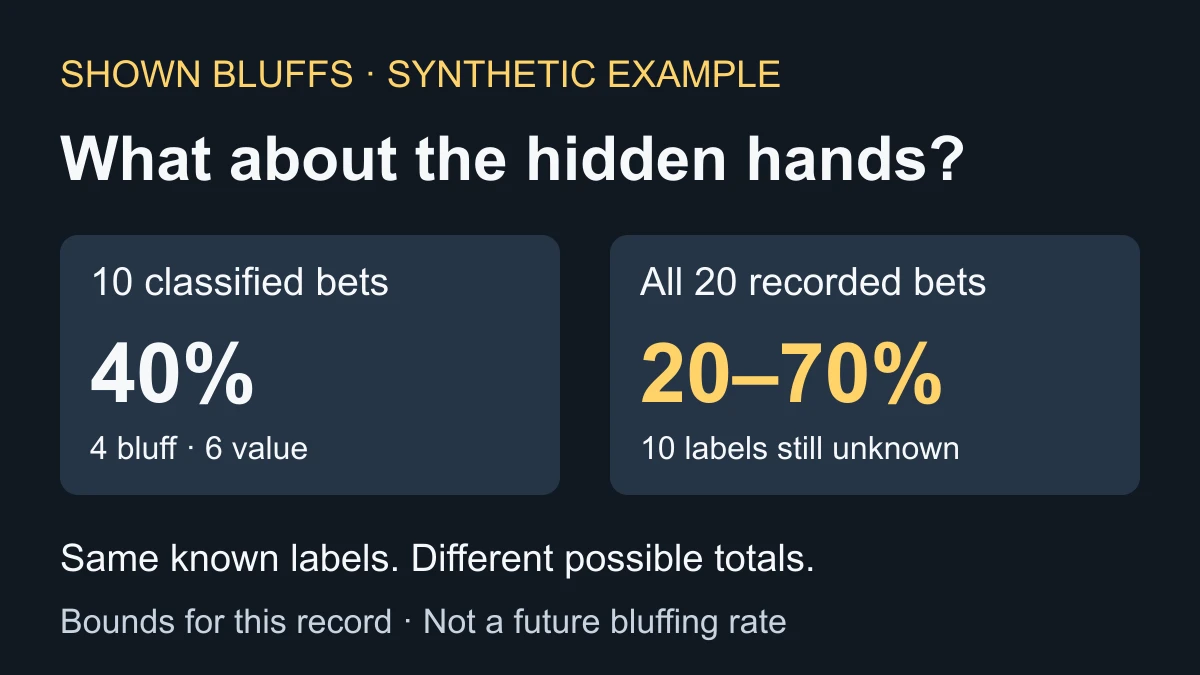
If ten revealed bets can be correctly classified and four are bluffs, the bluff share of that classified group is 40%. It does not establish that an opponent bluffs 40% of the time they bet. The hands you see have passed through calling, folding and disclosure decisions. Hidden hands can have a different composition, and visible cards do not always settle whether a bet was a bluff.
Here is a small example you can inspect completely: twenty invented river bets, with four classified as bluffs, six as value bets and ten left unknown. The classified fraction is 40%. Under the example's binary labels, the bluff fraction across all twenty bets can be anywhere from 20% to 70%, in five-percentage-point steps. Both endpoints fit the same observed record.
Why a revealed hand is a selected observation
A bet that gets called can produce different information from one that wins without a call. Even after a hand ends, showing can be optional: PokerStars' current show-or-muck instructions describe settings and choices for showing winning hands after opponents fold, as well as mucking. That is an example of a disclosure mechanism, not a universal rule for every room.
You may see a hand because someone called or because the bettor chose to show it. Also distinguish what appeared on screen from what you can legitimately review later: PokerStars documents some mucked showdown cards in participants' hand histories. Its help page distinguishes those from cards folded facing a bet. Do not equate “mucked on screen” with “permanently unknown.” A collection of memorable reveals is therefore not automatically a random sample of all bets. Nothing here assumes that people preferentially show bluffs rather than value; either direction needs evidence.
The research paper Bayes' Bluff (UAI 2005), section 3.3, explicitly distinguishes observations with known opponent cards from those with hidden cards. Its model sums over possible hidden holdings. That illustrates why missing cards belong inside an inference model; simply deleting those observations is a different procedure. Our exercise below is a counting demonstration, not an implementation of that Bayesian model.
Keep the label separate from the cards
For this exercise, every bet has exactly one stipulated underlying label: bluff or value. The ten revealed bets are classified correctly. Think of a teaching dataset whose author knows the labels, not a person whose intentions become certain when their cards appear.
Real hands are less tidy. A losing bet can have been intended for thin value; a winning bet can have been intended as a bluff. A merged bet may resist either label. If you cannot justify the classification, keep it unknown even when the cards are visible.
The synthetic record contains all twenty eligible bets from one declared context. Each has a unique ID. We are measuring the bluff share among those bets, not bets per dealt hand, per river opportunity, or per session. In an actual review, define the bettor, format, positions, stack conditions, board/action context, sizing and observation window before collecting the denominator.
Two hidden worlds, one visible record
The twenty-bet record
Bets 01–04 have known bluff labels. Bets 05–10 have known value labels. Bets 11–20 have unknown labels. The observed classification fraction is 4 / (4 + 6) = 40%.
Assign all ten unknowns to value and the completed record has 4 bluffs in 20 bets. Assign all ten to bluff and it has 14 in 20. Neither assignment changes a single observed label.
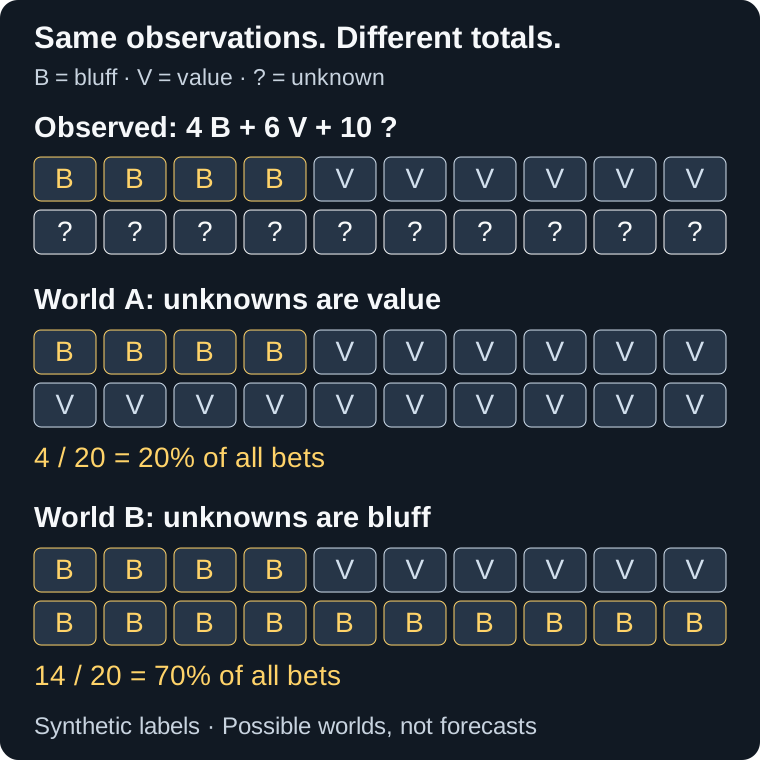
On a narrow screen, scroll the table horizontally to compare both worlds.
| Record | Known B / V | Ten unknowns | All-bet bluff share |
|---|---|---|---|
| World A | 4 / 6 | All value | 4 / 20 = 20% |
| World B | 4 / 6 | All bluff | 14 / 20 = 70% |
Open the missing-label workshop to move between the eleven possible totals. It keeps the observed labels fixed and changes only the hypothetical unknown labels. It does not estimate which completion is more likely.
Calculate bounds for a complete record
Let B be the known bluff count, V the known value count and U the unknown count. With N = B + V + U and N greater than zero, the smallest compatible bluff fraction is B / N; the largest is (B + U) / N.
The proof is just counting. None of the unknown labels can remove a known bluff, and at most all U unknowns can add one. Assigning every unknown to value reaches the lower endpoint; assigning every unknown to bluff reaches the upper. For our record, those are 4/20 and 14/20.
The width is U/N: here, 10/20 = 50 percentage points. If all labels become known correctly, the endpoints coincide. If none is known, the bounds are 0–100%. If you do not know how many eligible bets occurred, you do not have the N needed for this calculation.
Resolve one unknown correctly and the arithmetic changes. If bet 11 is value, the bounds become 4/20 to 13/20: 20–65%. If it is bluff, they become 5/20 to 14/20: 25–70%. Either resolution removes one unknown and narrows the width by five percentage points. It does not choose labels for the other nine.
These are bounds on a fixed completed record under declared label assumptions. They are not a 95% confidence interval, a posterior probability range or a forecast of an opponent's next bet.
More shown hands do not settle the selection question
Imagine a larger synthetic record with the same proportions: 400 known bluffs, 600 known value bets and 1,000 unknowns. The classified share is still 40%; the full-record bounds remain 20–70%. The unknown fraction is still one half of the record, so its bound width is still fifty percentage points. Increasing the counts alone has not constrained how those unknown labels are assigned.
Our poker-stat sample-size guide addresses a different question: sampling uncertainty when you have defined action counts and comparable opportunities under a statistical model. A confidence interval around the classified observations cannot, on its own, establish that the hidden observations have the same composition.
Additional assumptions or evidence can narrow the possibilities. Charles Manski's Inference with Imputed Data, section 3.1, separates the contributions from observed and missing outcomes; connecting the two requires assumptions. Our finite-record counting exercise illustrates that distinction without estimating a population parameter. For example, a justified observation model could connect disclosure to holdings and actions. An authorized fuller hand history might resolve particular unknowns. Neither step permits silently assigning every unshown hand to value, or copying the shown-hand fraction into the unshown group.
Write the observation you actually have
First count every eligible bet, including unshown bets. A list of twenty memorable reveals is not a complete twenty-bet denominator. If completeness is unknown, report that limitation instead of calculating these bounds.
Replace “bluffs 40%” with a note like this: “Twenty comparable river bets recorded; four classified bluff, six classified value, ten unknown. Classified share 40%; classification and disclosure assumptions still need review.” Keep the supporting cards, action sequence and information source alongside each label. Our hand-notes guide helps preserve missing details without inventing them.
Separate why a label is unknown: cards never observed, incomplete history, or visible cards whose betting purpose remains ambiguous. Also record how known cards became available. That lets later evidence change the relevant row instead of turning one striking reveal into a permanent player label.
For off-table practice, Live Poker Trainer offers practice against specified opponent models. Use those models to explore a declared assumption; they do not identify which model fits a real opponent from shown cards. GTO Solutions AS publishes both the app and this article. Product information was checked September 6, 2026; this exercise does not test the app or claim that it computes these bounds.
Method and downloads
We created twenty synthetic IDs and enumerated all 210 = 1,024 binary assignments to the ten unknown labels. Every assignment preserves the ten known labels. The resulting complete-record bluff fractions have eleven distinct values, from 20% through 70% in five-point steps. Enumeration gives possibilities, not probabilities: we did not assume the assignments are equally likely.
Download the observed record, two endpoint completions, exact results, generator, independent verifier and reproduction instructions. The checksum file covers the public bundle. No real players, private histories, solver ranges or random simulation were used.
The exercise does not establish bluff intent from cards, correct misclassification, recover omitted bets, validate a tracker, or determine a calling strategy. Even a fully labeled past record does not by itself establish a stable future rate.
- PokerStars, Show or muck your cards: operator-specific disclosure options; accessed September 6, 2026.
- Southey and colleagues, Bayes' Bluff: Opponent Modelling in Poker, UAI 2005, section 3.3: distinct observation likelihoods for known and hidden cards; accessed September 6, 2026.
- PokerStars, Cards mucked in hand histories: distinction between visible display and authorized history; accessed September 6, 2026.
- Charles F. Manski, Inference with Imputed Data, May 2022, section 3.1: observed and missing outcome decomposition; accessed September 6, 2026.
- GTO Solutions AS, Live Poker Trainer, US App Store: specified opponent-model practice; accessed September 6, 2026.