
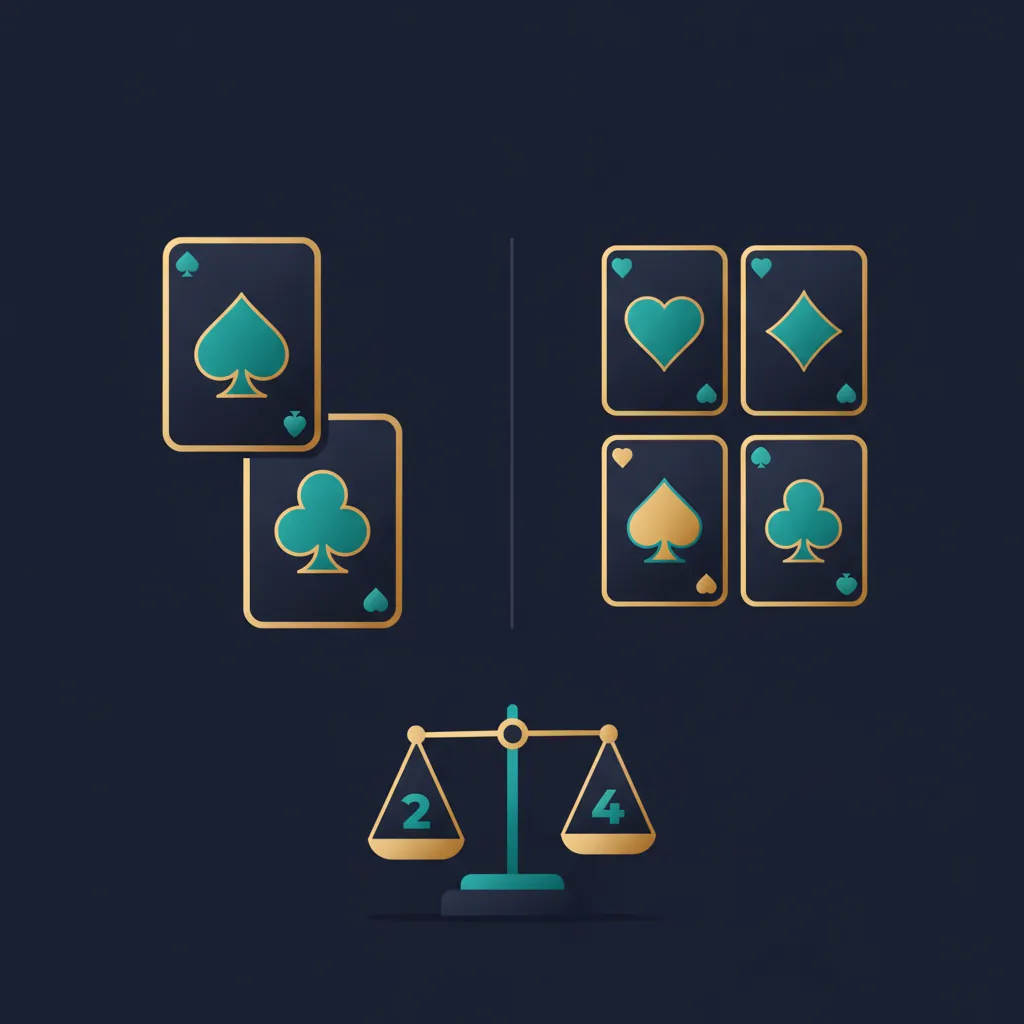
The PLO vs NLHE question comes down to four structural changes: Omaha deals you four hole cards instead of two, forces you to use exactly two of them, caps every bet at the size of the pot, and squeezes preflop equities much closer together. Everything else, the action, the swings, the softer pools, follows from those four rules.
Disclosure: This guide is published by GTO Gecko. We make GTO Gecko for No Limit Hold'em and PLO Gecko for Omaha; both appear in the study sections below. The structural comparison stands on its own.
What Is the Difference Between PLO and NLHE?
Pot Limit Omaha deals each player four hole cards (five in PLO5) and requires exactly two of them, combined with exactly three board cards, to make a hand. No Limit Texas Hold'em deals two hole cards, lets you use any combination of them, and lets you bet your entire stack at any moment. PLO caps each bet at the current pot size instead.
| Structure | NLHE | PLO |
|---|---|---|
| Hole cards | 2 | 4 (5 in PLO5) |
| Hand construction | Any combination of hole and board cards | Exactly 2 hole cards plus exactly 3 board cards |
| Starting hand combos | 1,326 | 270,725 (2,598,960 in PLO5) |
| Best hand vs random hand | AA wins roughly 85% of the time | AAxx wins roughly 65 to 72%, depending on side cards |
| Hand values at showdown | One pair wins many pots | Big pots go to the nuts or close to it |
| Betting structure | No limit, all-in available at any time | Pot limit, maximum raise equals the pot |
| Variance | High | Higher, because equities run closer and pots still grow fast |
The exactly-two rule punishes Hold'em players first. Hold one heart while four hearts sit on the board and you have a flush in Hold'em. In Omaha you have nothing, because a flush requires two hearts from your own hand. Every transitioning player pays this tax at least once.
The combinatorics matter too. Hold'em has 1,326 possible starting hands; four-card Omaha has 270,725, each containing six two-card combinations. PLO preflop play revolves around how well those combinations coordinate, a topic our PLO strategy guide covers in depth.
How Do Hand Values Change from Hold'em to Omaha?
Every hand value shifts up a full tier. With six two-card combinations per player (ten in PLO5), somebody has usually connected hard with the board, so the winning hand in a big Omaha pot is far stronger on average. One pair, even an overpair of aces, becomes a bluff catcher the moment serious money goes in.
Example: aces are not the same hand
You hold A♦A♣7♦2♣ on a J♠T♠4♥ flop. In Hold'em an overpair here is a clear value hand. In PLO an opponent holding K♠Q♦9♥8♠ has a 17-card wrap (any ace, king, nine, eight, or seven makes a straight) plus a flush draw and is a favorite against your bare aces, despite holding king high. The biggest PLO wraps reach 20 outs.
This is why PLO players obsess over the nuts. A non-nut flush or the low end of a straight loses stacks in Omaha far more often than in Hold'em. Counting outs against the price you are offered matters on nearly every street; if that math is rusty, review pot odds and poker math before sitting in a PLO game.
Why Is PLO Higher Variance Than NLHE?
On variance, Omaha vs Texas Hold'em is no contest: PLO swings harder because equities run closer at every stage while pots still grow geometrically. A preflop all-in that is 80/20 in Hold'em is often 60/40 in Omaha. Postflop, made hands face draws with 15 or more outs, so even your best situations get outdrawn at rates Hold'em players find alarming. You can play well and still lose for a long stretch, and the reverse is just as true.
Pot-limit betting does not tame this. It slows the preflop all-in, but by the turn the pot is usually large enough that a single pot-size bet puts stacks in play anyway.
The bankroll consequence is direct. A cushion that feels comfortable in NLHE is usually too thin for PLO at the same stakes; common practice among PLO regulars is to hold roughly double the buy-ins they would keep for Hold'em, or to drop a stake. Our guide to bankroll management for serious players shows how to size that cushion around your own risk of ruin.
Which Game Suits Which Player?
Choose NLHE if you want lower swings, games running at every stake, and the deepest study ecosystem in poker. Choose PLO if you enjoy postflop complexity, have bankroll headroom, and can evaluate your play by decisions rather than results. Three questions settle it.
| Question | NLHE fits when | PLO fits when |
|---|---|---|
| Bankroll | Your roll covers a standard cash cushion with little room to spare | You can hold roughly double the buy-ins, or willingly drop a stake |
| Temperament | Losing with strong hands tilts you, so fewer coolers helps | You stay level through 60/40s losing three times in a row |
| Study appetite | You will grind theory to keep up with a well-studied pool | You want modest, focused study to translate into an edge faster |
Temperament is the filter most players skip. PLO manufactures coolers by design: set over set, wrap versus top set, nut flush draw versus current nuts. If variance reads as injustice to you, PLO will grind you down regardless of skill. If it reads as the cost of doing business, it is one of the most rewarding games in poker.
Does Skill Transfer Between NLHE and PLO?
Yes, in both directions, more than most players expect. The core disciplines of poker are game-agnostic: position, pot odds, thinking in ranges instead of single hands, and matching bet sizes to a purpose all carry straight over. If ranges are still fuzzy for you, understanding ranges in poker is the shared foundation for both games.
Moving from Hold'em to Omaha, what breaks is calibration. Your instincts about hand strength are systematically too optimistic, your preflop habits do not survive four coordinated cards, and your bluffing frequencies need rebuilding around blockers to the nuts.
Moving from Omaha to Hold'em, players arrive with excellent draw equity intuition, comfort in big pots, and fast board reading. They must relearn how strong one pair really is, how wide thin value betting goes, and how no-limit leverage from shoves and overbets works. A refresher on how poker equity works helps recalibrate in either direction.
Are PLO Games Softer Than NLHE?
Often, at comparable stakes, though it varies by site, stake, and time of day; nobody has a universal statistic. The argument is structural rather than empirical. Cheap, abundant solver tools mean the average Hold'em regular has seen solver output for the spots you will put them in. PLO solving is computationally far heavier and its tool ecosystem younger; deep solutions historically required desktop software like MonkerSolver and serious hardware. The average PLO player has had less access to solver-grade feedback.
PLO also self-selects for action players; four cards make every hand look playable, and many opponents play far too many of them.
Two caveats. High-stakes PLO pools are full of specialists and are not soft. And a softer pool is not free money, because variance delays and disguises your edge. Softer means your study hours convert to expected value faster, not that the money shows up this week.
How Do You Study NLHE?
Hold'em study in 2026 is a solved workflow: browse solver ranges, drill them with EV feedback, and review mistakes by category. GTO Gecko is our tool for exactly that loop. It covers cash games, MTTs, and Spins with preflop, postflop, and full-hand trainers, grades every decision by EV loss, tracks progress with an ELO rating, and adds an Explain feature that uses machine learning (XGBoost with SHAP values) to explain in plain English why an action is preferred. Paid plans add an on-device custom postflop solver.
It runs in the browser at play.gtogecko.com and natively on iOS, Android, and macOS, one subscription syncing across all of them. On Google Play it holds a 4.77 rating with over 10,000 downloads, and its 288 App Store ratings worldwide average about 4.8. A free account includes preflop range browsing and a daily trainer allowance; access limits can change, so check the current product page.
How Do You Study PLO?
The Omaha study ecosystem is smaller, which is the softness argument above, but no longer empty. PLO Gecko (formerly PLO Edge), our sister app for Omaha, packs the same drill-and-feedback loop into a mobile trainer. It covers both PLO4 and PLO5 with progress tracked separately, offers 31 structured training modules from RFI through 3-bet pots, squeezes, and blind defense (14 of them dedicated PLO5 preflop modules), and scores every decision against solver-based GTO frequencies, grading each move from perfect to blunder.
Standout features include native river solving on iPhone and iPad inside PLO5 full-hand drills, an interactive preflop range viewer with exact solver frequencies and EV per hand, leak detection that flags over-folding and passivity, and tools like a Monte Carlo equity calculator and a wrap analyzer with nut-out grading. The free tier gives you 25 training hands and 50 range lookups per day, with monthly and yearly plans unlocking the rest.
PLO Gecko is rated 4.5 stars on the US App Store. You can get it on the App Store or Google Play, or read the full feature rundown on the PLO Gecko page. For the five-card variant specifically, our PLO5 strategy guide pairs well with those 14 PLO5 modules.
Credit where due: PLO Mastermind remains a strong video theory library, and MonkerSolver is still the reference for deep custom desktop solves. Our roundup of PLO trainer apps compares the whole field honestly, and our PLO Gecko trainer guide walks through the app itself in detail.
Should You Play Both Games?
Eventually, yes. Two-game players can sit wherever the softer table is, and each game sharpens the other: Omaha teaches respect for draws and board textures, Hold'em teaches precision with thin value and bluff frequencies.
A path that works:
- Keep your current game as the base. Your win rate there funds the experiment.
- Learn the second game's rules cold. For PLO that means the exactly-two rule and pot-limit raise math.
- Drill preflop before playing. Twenty trainer hands a day build hand selection faster than sessions do. The free daily allowances in PLO Gecko and GTO Gecko cover this stage.
- Enter one or two stakes below your main game. Your edge is smaller and the variance, in PLO's case, is larger.
- Track the two bankrolls separately. You want to know what each game actually earns before mixing money.
Ten minutes per game per day is a sustainable pace. Both apps fit on the same phone for a reason.
Frequently Asked Questions
Is PLO harder to learn than NLHE?
The rules take an extra evening, mostly the exactly-two-cards requirement, but competent play takes longer because every decision weighs six or ten two-card combinations instead of one. Hand reading is genuinely harder. Preflop, however, is more forgiving of small errors than Hold'em, since equities between playable hands run close together.
Is PLO more profitable than NLHE?
Neither game is inherently more profitable; your edge over the specific pool decides that. The structural case for PLO is that its pools have had less access to solver study, so the same study hours can buy a bigger edge. The counterweight is higher variance, which delays and disguises that edge. Measure your own results.
Do I need a bigger bankroll for PLO?
Yes. Equities run closer, so winning players endure longer and deeper downswings than in NLHE at the same stakes. Common practice is to keep a substantially deeper buy-in cushion for PLO, often around twice your Hold'em cushion, or to play a stake lower until your sample proves an edge.
Does PLO Gecko cover 5-card PLO?
Yes. PLO Gecko supports both PLO4 and PLO5, switchable in one tap with progress tracked separately per variant. Of its 31 training modules, 14 are dedicated PLO5 preflop modules, and PLO5 full-hand drills include native river solving on iPhone and iPad. Preflop ranges for PLO5 are solver-built at 100bb.
Do GTO Gecko and PLO Gecko share one subscription?
No, they are separate apps with separate subscriptions. GTO Gecko covers No Limit Hold'em across web, iOS, Android, and macOS with one subscription syncing across platforms. PLO Gecko covers Omaha on iOS and Android with monthly and yearly plans. Both offer free daily allowances, so you can try each before paying.
Pick Your Game and Start Drilling
The comparison only matters once you act on it. If Hold'em is your game, open the GTO Gecko trainer and drill one position pair today. If four cards are calling, grab PLO Gecko from the App Store or Google Play and run your first 25 free hands tonight. Either way, the player who drills daily beats the player who debates formats.